“How’s everybody feeling today?” Aryeh asks the crowd of thirty-odd people gathered at a bus stop on the fringes of downtown Toronto. In response, there’s sparse, nervous laughter. “No, really,” says Aryeh. “What does it feel like to be alive today?”
Horrible, whispers a woman behind me.
Undeterred, Aryeh presses on. “We’re going to feel for real today,” he tells us, before leading the group through a ramshackle guided meditation, encouraging us to pay attention to the sights and smells and sounds that surround us. I take in the pillowy, slate-coloured sky, the wads of gum mixed with concrete at my feet, the faint smell of cooking oil. At that moment, a child screams and a flock of pigeons crashes into the crowd; a few of us duck for cover. “Yes,” says Aryeh, laughing. “Even that.”
Aryeh, wearing jeans, a t-shirt, and a colourful cap with a propeller atop, is here to take us to the mall—or, more accurately, to several malls, most of which are almost completely abandoned. In his spare time, he runs an organization called Liminal Assembly, which shuttles people through a series of decaying suburban shopping malls around the Greater Toronto Area, places that seem stuck in purgatory between eras, at once eerie and beseeching.
I look around. We’re mostly in our late twenties and thirties; some by ourselves, some in pairs. Many of us have cameras slung around our necks. The woman behind me who whispered earlier has delicate tattoos and oversized sunglasses, her female companion in converse sneakers. It occurs to me that most of us probably came of age in malls, our first taste of independence the sweet, cold pull of an Orange Julius at the food court, a trip with middle-school friends to find the perfect pair of jeans, hair clips, boy band CDs.
A rented school bus pulls up and we slide into its cracked leather seats. It lurches away from the curb, en route to the suburbs. “Alright,” says Aryeh, patrolling the bus’s centre aisle, a teeny microphone pinched between his fingertips. “Are you guys ready to go to the mall?”
***
As the condo towers of downtown recede, giving way to what seems like endless lanes of highways, I retrace the steps that led me here. Last winter, I stumbled upon an Instagram post advertising a party being held at an aging retail complex in Toronto’s Yorkville neighbourhood. Cumberland Terrace had somehow occupied the corner of Bay and Bloor Streets since the 1970s, wedged between luxury towers and some of Canada’s most expensive commercial real estate. I’d cut through Cumberland Terrace’s ghostly pathways hundreds of times en route to the subway, perplexed by its perpetually shuttered food court and wall of pay phones, its increasingly dwindling storefronts selling pantyhose, notary services, fake sixteenth-century Chinese pottery. It seemed out of place, occupying neither past nor present. The terrace, it seemed, was finally slated for demolition, and Aryeh wanted to fill the mall with people and recreate its zenith, or, as he put it, “do business like it’s 1984.” I went to the party, which is where I met Aryeh, and where I learned he gives “dead mall tours” on a regular basis.
Aryeh’s tours have gained a cult following, often attracting people obsessed with “liminal spaces,” a term given to places that represent in-between stages, connecting two different eras or experiences. By this definition, a parking lot or an empty hallway can be considered a liminal space, as can an abandoned structure, paused mid-demolition. Many people report feeling unsettled or haunted in liminal spaces, and some anthropologists believe this is because our bodies innately know we’re not supposed to dwell in them. They are, after all, not a destination, but a portal, a gateway to another world. But despite this disconnect, many people report feeling a strange, forbidden pull towards liminal spaces. There are digital and in-person communities around the world dedicated to sharing these experiences. r/LiminalSpace on Reddit, for example, has one million followers who post daily photos of bridges and doorways and food courts, of highways that stretch into oblivion. “Dude, that’s so liminal,” others will respond.
For the liminal space curious, semi-abandoned suburban shopping malls are a perfect example of this phenomenon: something purpose-built that’s long-since lost that purpose, yet sits in limbo awaiting its next iteration—a nod to the past, an amorphous fumble toward the future.
But I didn’t know any of this as I slipped into the crowd at Cumberland Terrace on that winter day. I was surprised at the diversity of the people who joined the send off: hipsters, tourists, students, even a few senior couples who strolled the fluorescent, mirrored hallways hand-in-hand, perhaps imagining the mall’s glory days, a 1980s meet-cute at the Italian deli stall when the food court was still open. Days later, I called Aryeh to ask what he thought was the appeal of these deserted, liminal spaces, expecting him to say something about nostalgia and ’90s kids who simply can’t get with the times. But the depth and complexity of Aryeh’s answer surprised me. Nostalgia is part of it, he admitted. People want a reminder of simpler times, when they weren’t bombarded with “the technological future and all this short-form content.” But Aryeh told me that standing in the wreckage of these spaces unlocks a sensation people often crave, but can’t name. He called it a “rare emotion,” the same haunted feeling one experiences after a particularly powerful piece of literature or music.
“When you go to these places that have what I like to say is importance built into them, in the detail of the tiles and the polished brass railings and all these elements, they suggest this place is a very important place,” he said. “But when you see it empty, there’s something very uncanny and eerie about that…You feel things and go, ‘huh, that is really unique.’ And I think that is the escape that people feel when they come to these liminal spaces.” He told me this is a feeling that seems to transcend cultures and geographies, that many people report feeling relieved and delighted when they find there are others who experience this pang of emotion in these spaces. “It’s something core in the human experience.”
***
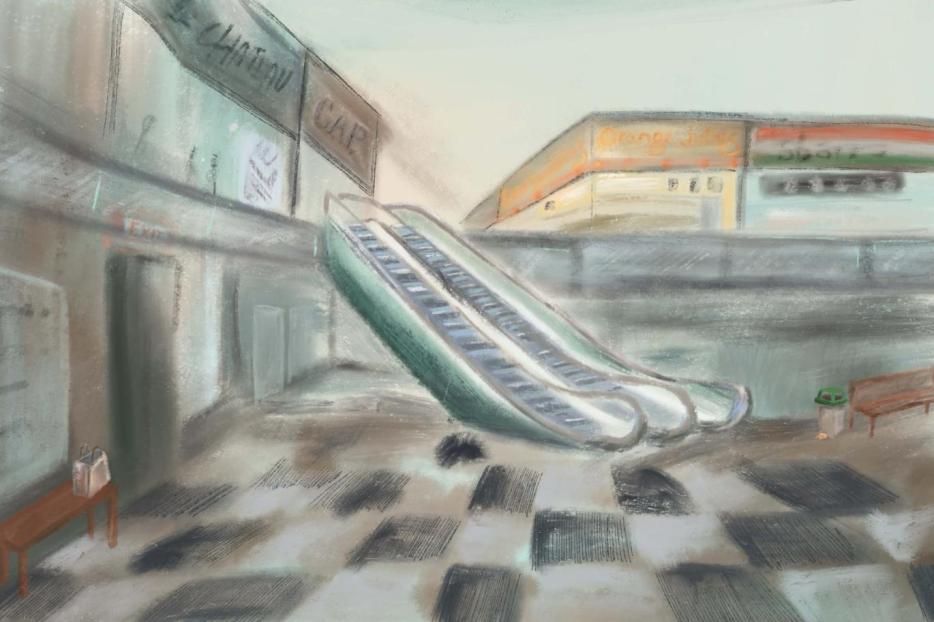
Our first stop on the dead mall tour is a strip mall originally built in 1969 and seemingly stuck mid-redevelopment. I follow the group inside and take in the mall’s main floor: as bright and gleaming as an operating room, with showrooms selling barbecues, luxury appliances, velvet headboards. It seems like these stores are mainly there to cater to the developer that’s in charge of building a series of condo towers on the site, which is the eventual plan. The space is largely devoid of people. Down one hall, abandoned scaffolding rests against the wall, white and skeletal. Aryeh has asked us to convene in the mall’s largely untouched lower level so I take the escalator one floor down, where I’m greeted by the remnants of a massive fountain. Without water, it’s reminiscent of a grounded UFO. A sign suspended by chains reads “Prohibited.” Down here most of the storefronts are empty, cracks on the beige floor tiles spreading like cobwebs.
“How does it feel to be walking around in this space?” Aryeh asks when we’re all gathered at the foot of the fountain. There’s an awkward silence before someone answers, “heavy.” People nod and shuffle their feet.
“Let’s walk in silence together,” says Aryeh. He cues up soft orchestral music on a walkman, and we follow him down a hushed hallway, past a glass elevator that’s out of service, its inner workings on display. The combination of quavering flutes and solemn, unfamiliar corridors is disquieting. I feel like I’ve accidentally crashed someone’s funeral. I’m starting to understand that part of the appeal for Aryeh is encouraging his tour guests to be fully present in their bodies and surroundings, something that actually does feel easier when we’re immersed in these physical, archival spaces, the ghosts of the 1990s lapping at our ankles.
***
Back on the bus, the woman sitting in front of me turns around. She’s wearing a denim jacket over a sundress, a silver stud glinting in her nose. “I’m Christa,” she chirps. She tells me she’s a teacher. I explain that I work as a journalist, and ask what her interest in liminal spaces is.
She thinks about it for a minute, her face thoughtful. Then she tells me she thinks we’ve accidentally re-engineered our lives so that the “dominant” parts of them are, in fact, liminal. We’re always searching for the next big thing, the next important life stage or accomplishment, she says. When we get to that stage, instead of enjoying the moment, we’re immediately off in search of the next milestone. Our lives, she seems to say, have become one big, empty mall corridor.
“I mean, we’re all wanderers, just wandering toward the end,” she concludes with an ominous wave of her hand that seems at odds with her cheerful disposition.
***
But if humans themselves are in a constant search for optimization and self-improvement, so are cities as a whole. And malls, with their single-storey forms, plopped amongst a sea of unused parking spots (what some real estate developers call “lazy land”) are easy targets for the chopping block. Between 2017 and 2022, an average of 1,170 malls closed each year in the United States, nearly twice as many as during the period between 1986 and 2017. In my work as a journalist, which sometimes involves covering the urban planning beat, countless economists and land use planners have told me that the rise of e-commerce, a global recession, and population growth requiring new housing has created a perfect storm for the demise of these spaces. I tried to find data about mall closures or redevelopments in Canada, as we’re clearly not exempt from these same forces, but came up empty.
Regardless, malls are now considered so outdated that many North American municipalities—including Toronto, Metro Vancouver and Phoenix, Arizona—have unrolled mall redevelopment strategies. These often guide or incentivize the “intensification” of shopping and strip mall sites, imagining, in their wake, clusters of sleek luxury towers with airy retail units on their ground floors, side streets with artful shrubbery, places for pedestrians to sit and walk and admire the benefits of capitalism.
But as a mass trend, this hasn’t always worked out. Some redevelopment projects—like the mall we just visited with the Liminal Assembly—get stuck amid municipal red tape, while others fall victim to rising costs and construction labour shortages, leaving them in limbo, the gaping maws of excavators still poised in their parking lots. Other malls seem to be resisting this movement altogether, standing sentinel with their faux-brick tiling and plastic ferns, even as vendors abandon ship and their kiosks clank shut for the last time, having sold their final mutton roll or polyester-blend nightgown. Though our cities have always been susceptible to the whims of social, behavioral and economic forces, the truth is, even the most meticulous of plans sometimes go awry, leaving gaps between what we want and what we are given.
***
We make our way through the suburbs, spilling into low-rise malls that threaten to blur together as one: the same brown tiles and shuttered kiosks, the plastic trees and fountains parched of water. The murky glass atriums that soar over the retail corridors, now hushed and sleepy. The way all that’s left in these malls are stores that seem to sell a singular, specific item: Clocks Unlimited, Bikini Warehouse. On the bus between destinations, we talk about millennial childhoods, about the passage of time, about how disconcerting it feels to explain pivotal news events that shaped our youths, like 9/11, to a younger generation who has only the vaguest notion of them.
Christa pipes in: “Tell me about it. When students ask me about Y2K it becomes a history lesson.” We laugh, uneasily. The sands of time, and all that.
We pull into our final mall destination of the day, which Aryeh preemptively describes as “a beautiful and tragic space.” Inside, the main floor has been commandeered by a mishmash of cash-only Asian food stalls, which gives it the feel of a makeshift street market. On the mall’s perimeters, vendors sell DVDs, Filipino souvenirs, discount travel agency packages, while the building’s upper levels consist of carpeted banquet halls and space leased by a Chinese Baptist church. One or two of the walls have been painted a shade of bubblegum pink not found in nature. We run up and down the stairs, delighted by the open space, whispering to each other that there’s a payphone bank with real phonebooks from the ’90s. Of all the malls, this one feels like the most functional, as though unplugged from the “global mall system,” as Aryeh calls it. It’s gone back to the earth, becoming what its community really needs: cheap noodles and worship services and bootleg DVDs. Somewhere, a land developer is having a wet dream about turning this place into a utopian master-planned community, but for now it persists, a quiet dignity to its stubbornness.
I once read a comment on r/LiminalSpace likening the feeling of being in a liminal space to the sensation you get as you’re about to rappel off a cliff. Weight balanced between your foot and a rope, your body hovering over the drop, it’s a viscerally unsettling moment as you navigate two different experiences of gravity. But with that comes possibility, said the commenter, so many different futures awaiting as you leap into the chasm.
***
One rainy weekend months later, I convince a friend to join me for dinner at the Chinese restaurant attached to one of the malls on Aryeh’s tour. I’ve been dying to go there ever since we walked by its dusty green awnings—it seems like the kind of place that would either give you food poisoning or a dish so good you undergo some kind of spiritual experience. Inside, we settle into a booth and take in our surroundings: the smoky mirrored walls and plastic flowers, a “no smoking” sign taped to the wall. Dozens of empty tables, each with a pristine white tablecloth. It’s six o’clock on a Saturday night and we’re the only customers here.
We spoon steamed rice and Szechuan Beef back and forth, occasionally glancing at the mostly-empty mall corridors outside. Then, my gaze fixes on something to the left: a “reserved” sign atop one of the empty tables. It seems absurd—surely nobody calls to book a reservation at this place, and if they did, I doubt they would need to actually flag a table, one of thirty empty ones. I wonder how long it’s been there. Suddenly I can visualize this place in its heyday: the tables teeming with families out shopping, groups doing business over lunch, office colleagues from the second floor catching up on gossip after work. The clink of cutlery and the hiss of the grill, the clouds of steam rising off plates, the heady chaos that comes with a place of public convening, a destination as much as a place of transience. I feel a sudden pang of sadness looking at that singular ‘reserved’ tag, poised for a party that, seemingly, would never come.
We drive home. Somehow I feel it would have been less unsettling to come away with food poisoning.
***
On the final bus ride back into the city, Aryeh invites us to show off any souvenirs we’ve picked up during the tour, for a chance to win a Liminal Assembly-branded sweatshirt. Christa gleefully brandishes a page she’s ripped out of the phonebook that has her childhood address on it. “I stole this!” she stage whispers. But it's a young photographer named Anuj who is ultimately declared the winner. At one of the kiosks, he purchased a framed Japanese-issued Philippine peso, a form of currency issued by the Japanese government while they occupied the Philippines during World War II. The Japanese government outlawed other forms of currency on the island, though the peso itself was of low value, often referred to by Filipinos as “bayóng" or “bag” money, as in, you needed an entire bag of Japanese pesos to purchase anything of value. Anuj doesn’t say it outright, but the sentiment of depleting currency hangs in the air, of how any number of items—bills, malls, entire towns—can be devalued at will by social and political forces.
“That is very liminal,” someone mutters.
The sun is still out, sitting low in the pink sky as we pull off the expressway into the downtown core. We slouch in our seats, spent, subdued. At a traffic light, a bearded man stands on the corner with his pants around his knees, screaming at the sky.
“Well,” says someone from the front of the bus. “We’re back.”
I have the distinct sensation that this has all been some kind of fever dream, that if we were to turn this bus around and head back down the highway we’d never find those mall remnants again, that they only existed in today’s time and space. I crane my head out the window to look at the expressway as it melts into the horizon, grappling for some tangible proof. I didn’t think to buy a souvenir.