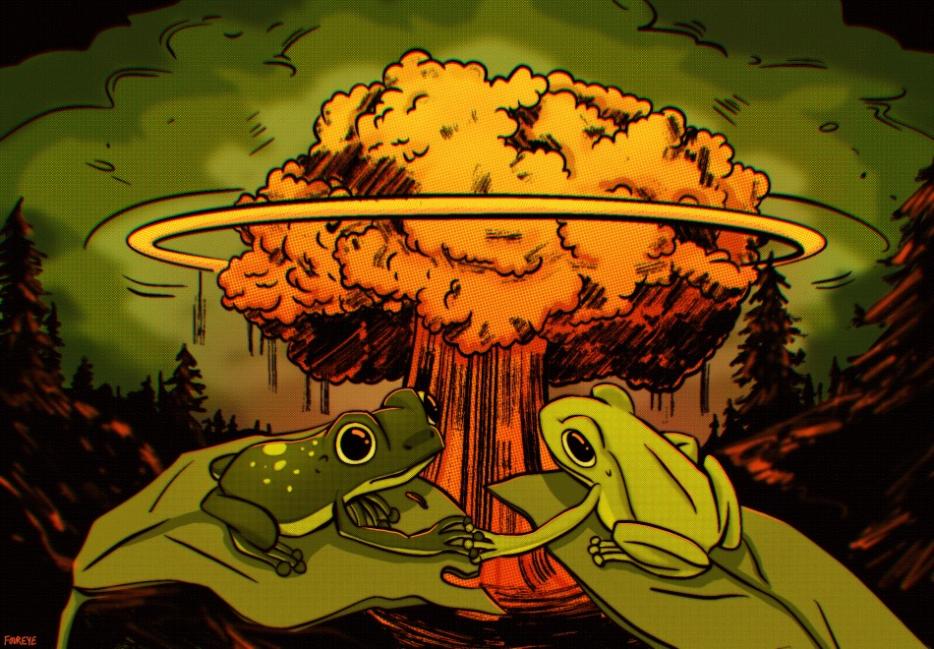
Long before frogs became an unexpected and impromptu symbol for resistance in America thanks to a handful of costume-wearing protestors in Portland earlier this fall, the past few years have been a golden age when it comes to something I’ve started calling frogposting.
Frogs and online posts are hardly brand-new bedfellows (see: the frog memes of yore, Pepe the Frog and Here Comes Dat Boi). I first noticed the early signs of this contemporary frogposting mode a few years ago. The various iterations were not so tight a grouping as to constitute a distinct meme, exactly—they didn’t reuse the exact same wording or visuals—but it was a vibe (or perhaps ethos) I started to see proliferating wherever young people gathered to post their thoughts.
In the intervening years, it feels like the trend has intensified rather than abated, turning the dusky sky of social media into a growing chorus of frog calls.
Of course, not all posts that constitute frogposting are actually about frogs. Many are about toads, or other amphibians. Many are small mammals (mice, raccoons, assorted rodents) while some are simply indeterminate cute little beings. Some are even about plants, rather than animals.
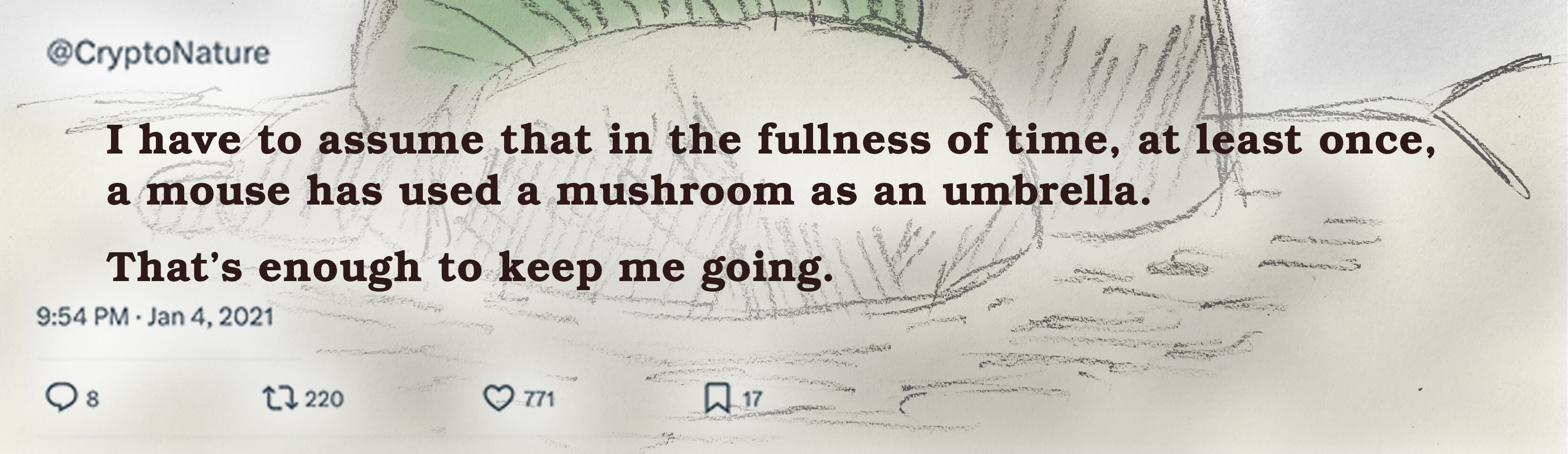
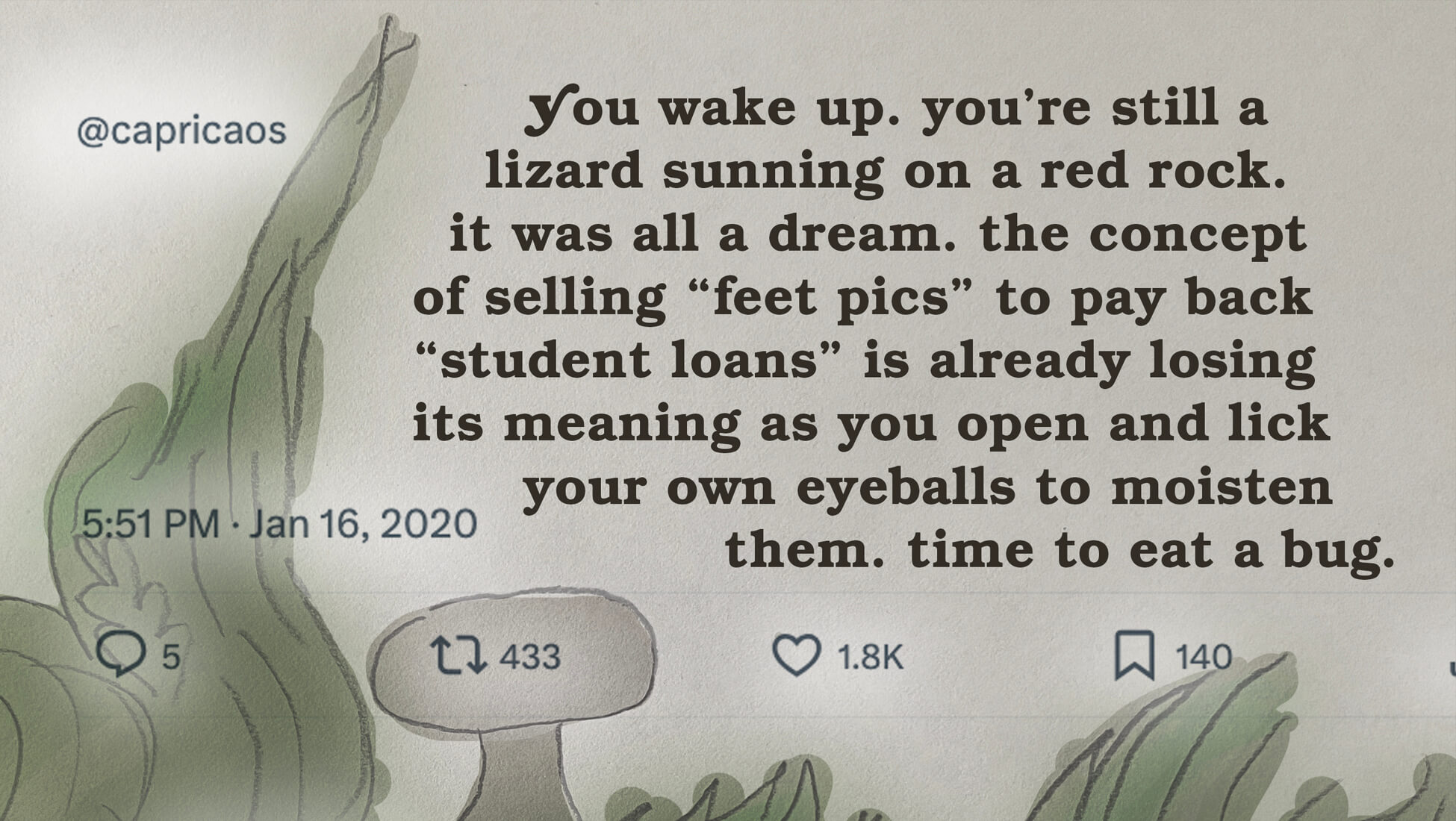
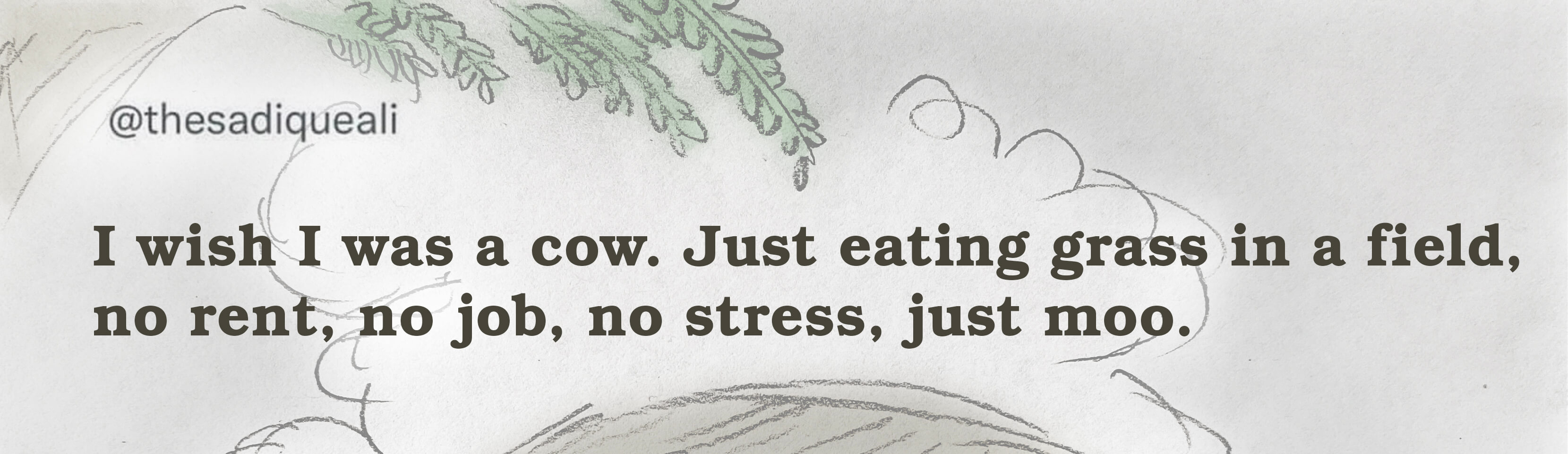
In fact, the screenshots of memes and posts I saved while working on this piece bring together a veritable zoological abecedary of creatures existing outside of modern society: a frog reading a book in a hammock; a frog and a snail who won’t be able to make it to work because, respectively, they’re a frog and a snail; a frog (or toad) who’s too busy at a dance party to come to work; a sweet little demure orange salamander; a baby monkey who’s got “no drama no opps im just chillin;” two ducks who’ve never had to download Tinder; a school of carp who’ve never had to reset a password; two lambs who were meant to lick dew from the pearly grass at dawn rather than write marketing emails; a well-dressed mole enjoying tea under a mushroom despite his lack of retirement plan; and, of course, the A-listers of the genre, the (queer-coded avant la lettre) children’s book characters Frog and Toad, created by the American author Arnold Lobel in 1970.
What ties all these critters altogether is that they are some combination of small, harmless, undomesticated and cute—but most importantly, not human. That’s right. Over the past few years, the hottest trend on social media seems to be fetishizing being turned into a woodland creature. Hell, there are now entire Instagram meme pages devoted to this alone. This, essentially, is frogposting. The genre crystallized for me when I came upon the following tweet, which feels to me like the quintessential expression of the form, as well as its namesake:
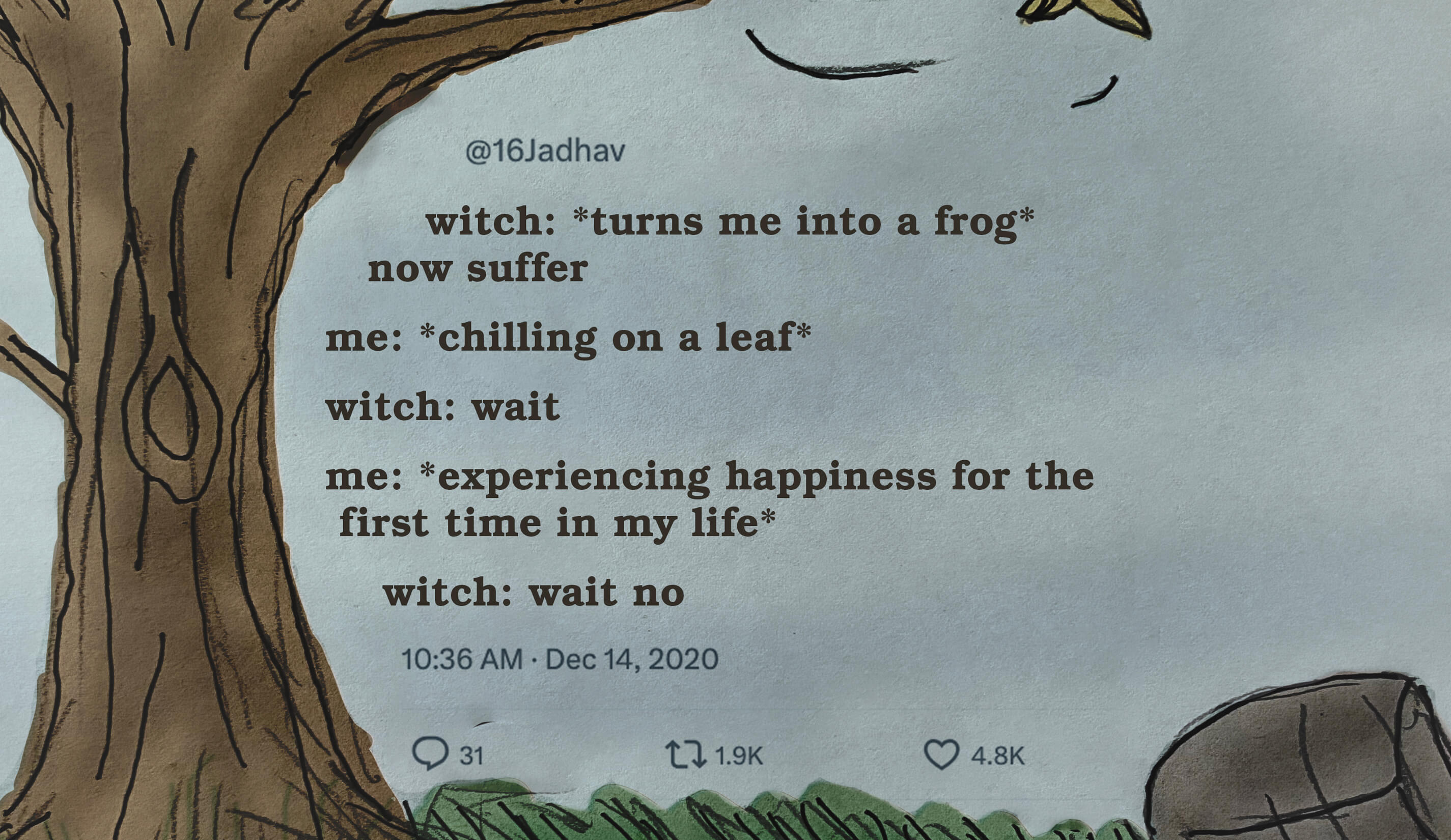
Though it seems to have taken off as of 2021, the above tweet and other examples of posts in the genre date back to the year prior, and it doesn’t really surprise me to imagine the pandemic accelerated the ascent of frogposting, because there’s more to it than simply the cute animals.
Despite the fact that Homo sapiens is an animal too, humans wanting to be other animals, or exploring the interplay between us and them, is not a new concept (see: most Disney animated movies, werewolves, the Animorphs books, every furry ever) but this particular wave seems to represent a different expression of the strain. Rather than prizing animals for their beauty, their virile traits or their straight-up cool characteristics, frogposting is all about vulnerable animals—the dweebs of the animal kingdom. Because, besides grouping together all these harmless, cute, tiny creatures, the ethos that runs through frogposting is a very twenty-first-century rejection of the complexities of modern human life.
***
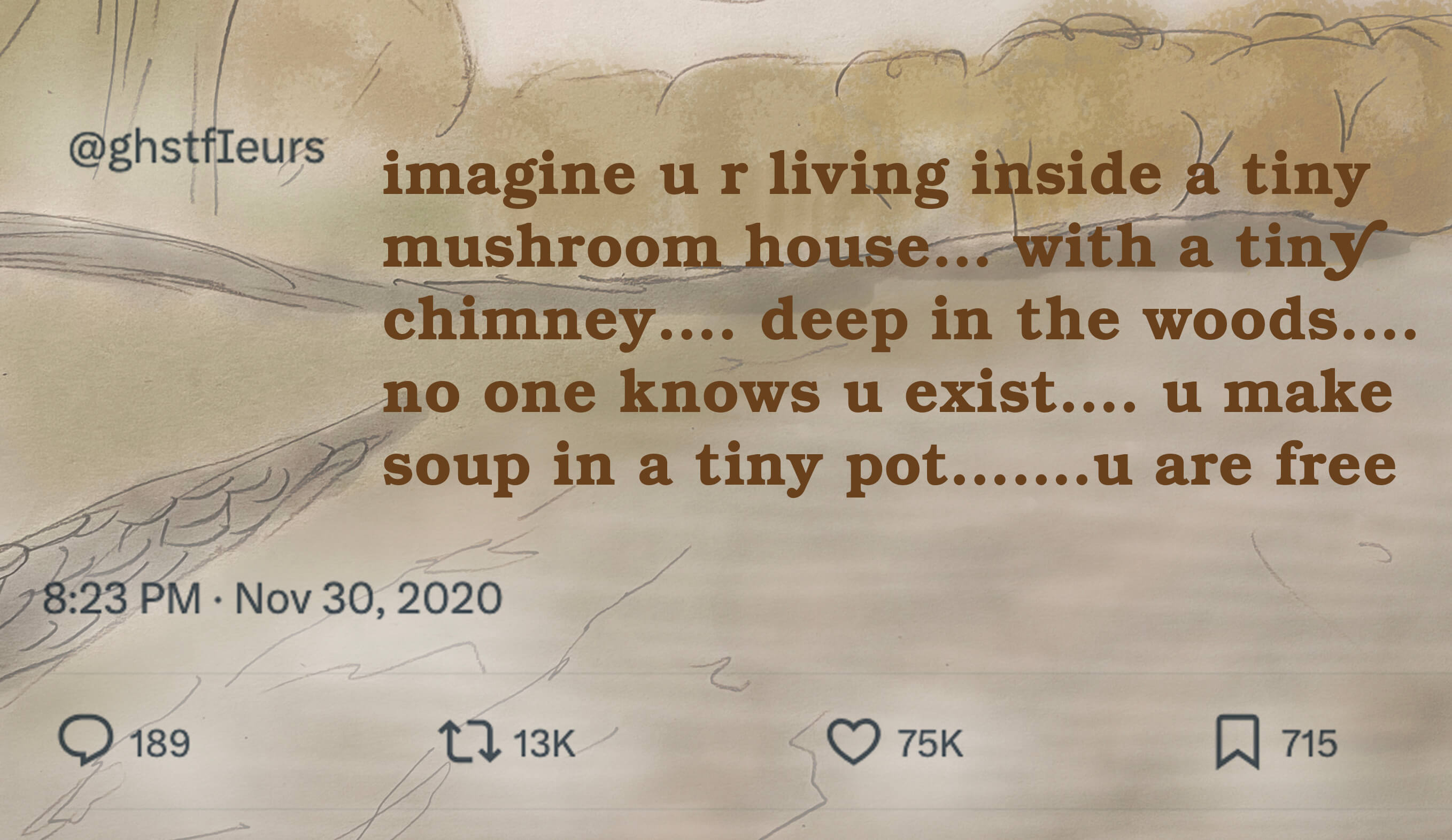
In yearning to be a tiny little creature seemingly without a care in the world, frogposters are eschewing what it means to be a person in our present moment. In a way, it’s very “reject modernity, embrace tradition.” The people who engage in and give likes and comments to frogposts must, on some level, recognize contemporary life for what it is: an unending succession of hurts and humiliations foisted upon humans by the structures of capital, the rise of tech, and the insurmountable tides of geopolitics in the era of the hashtag, the Black Friday sale, and the nation state. In this economy (as they say), we are all at the whims of decisions made by people so removed from the warmth of genuine humanity that they might as well be robots.
This is not uniquely an indictment of the powerful, but rather the structural nature of what they represent. They are captains of enormous ships that are near-impossible to steer off course; they occupy positions within institutions, roles that do not allow for genuine compassion and humanity. It doesn’t take much predictive talent to recognize that any CEO or president who woke up one day with a Grinch-like change of heart or mind and attempted to instill policies that genuinely benefited the masses at the expense of the powers that be would quickly find themselves without a job. As some democratically elected leaders (Allende, Mossadegh, Lumumba, just to name a few) found out in decades past, it can go much further than that. The fall 2024 murder of UnitedHealth CEO Brian Johnson, of course, shows us the flip side: whatever the public’s response, an extreme act of vigilantism like killing a single C-suite executive will not change the system in the slightest.
Ursula K. LeGuin famously said, “We live in capitalism. Its power seems inescapable. So did the divine right of kings.” Though that quote has given me comfort in dark times, at some point I realized there was an important structural difference between the overthrow of the two systems. If you depose the king of a nation and his family, there’s no more monarchy. The number of people who’d have to be removed from power, say, at a petrochemical company to halt operations is, one imagines, multiple orders of magnitude higher. Because questions of relation and bloodlines don’t factor into it, new would-be CEOs—endlessly replenishable resources—are always available to take the helm, with new bodyguards available to protect them.
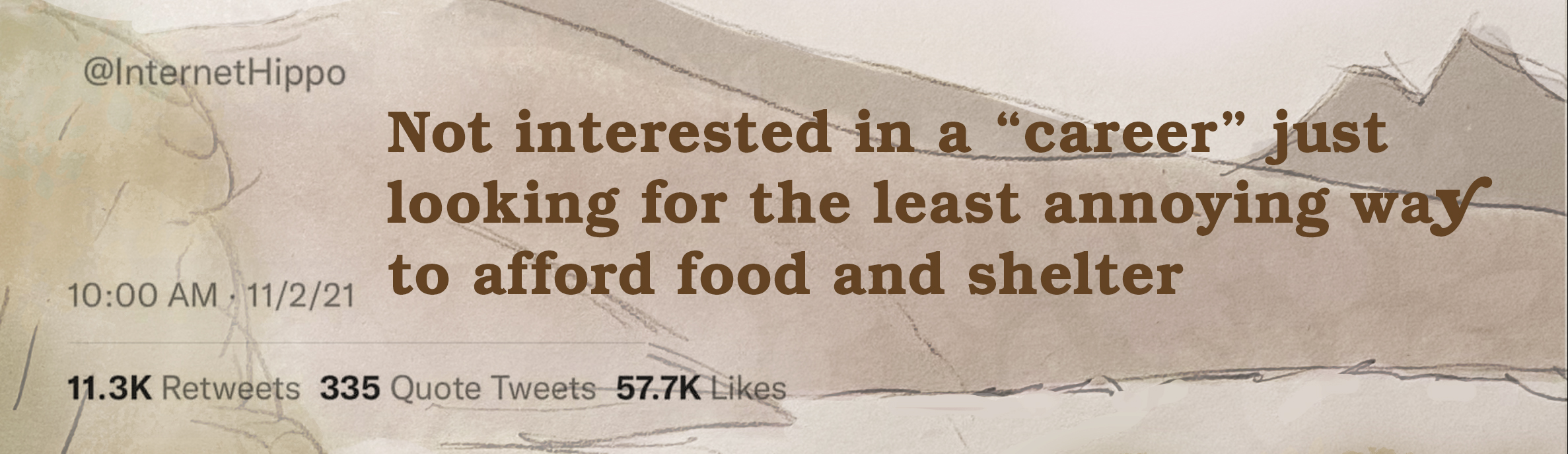
Frogposting, then, pits the intractably byzantine, soulless and cutthroat nature of the contemporary economy in a simple binary against what the posters envision as the green, healthy, naturalness of the Earth—framed as a joke, the base unit of online commentary. While some of these posts are simply gesturing towards the beauty of life outside the confines of late capitalism, often they go further, to the point where the author of the post is expressing a yearning to actually be an animal.
As with much of the content online these days, these sentiments never feel especially sincere, but the fact that I’ve seen so many posts along these lines go viral in recent years suggests that the sentiment resonates deeply with young people today who’ve grown up in a world where the idea of ‘making it’ or ever feeling financially secure seems well beyond the realm of the possible.

In the face of that reality—the death, functionally, of the American dream—millennials, Gen Zers and Gen Alphaers have started fantasizing about the abolition of money, of technology, of progress entirely, to the point of dreaming about regressing away from humanity itself.
To older people—to my elder millennial self, at times—these fantasies may feel like overcorrections. But they are also a reflection of the fact that human life on this planet has been inextricably enmeshed with the horrible, bloodthirsty logics of capitalism for so long that it’s now hard to conceive of it otherwise. Though in geologic time, the advent of the Industrial Revolution is only a hair’s breadth removed from our current moment, that’s cold comfort to people born after 9/11. To paraphrase the meme, all they know is McDonald’s, charge they phone, twerk, be bisexual, eat hot chip and lie—bound to the tracks of the trolley problem.

As such, it’s genuinely easier for many young people today to situate the idyllic pastoral in the realm of fiction with talking animals than it is for them to imagine real-live humans living without rent or credit card debt or career. And why not? It’s not like there’s incentive for the status quo to teach them about alternate modes of living.
Prehistoric collectivist agrarian societies that survived for hundreds or even thousands of years may be much closer to what these young people are actually yearning for, but posts that are more grounded in the reality of human prehistory are likely shown to significantly smaller and more niche crowds. We see the frogposts show up on our feeds because it’s a lot easier to go viral with a post where you fantasize about being a cute little country mouse than it is to publish impassioned screeds about returning to the egalitarian paradise of Çatalhöyük society circa 7,000 BCE in what is now southern Türkiye.
***
The frogposting mode is fascinating because it’s seemingly embraced primarily by the hyper-diverse and accepting youth of today despite its inherent backwards-looking qualities. The people making and liking these posts are not imagining being bugs and frogs and woodland mice in a far future, after capitalism (having sown the seeds of its own destruction) has finally collapsed; it’s an imagined past, a pastoral imaginary — or perhaps, in especially 2020s fashion, an alternate timeline in the multiverse.
Though the half-serious wishful thinking underlying the full-blown animal-life fetishization of real frogposting feels, at times, shortsighted, the genre is an understandable and unavoidable response to a modern life that can seem unrelentingly soul-crushing, where every moment of genuine human truth and connection is just a few financial quarters away from being optimized, synergized or turned into a freemium-model app.
As will happen to any sufficiently successful genre of online post, there are offshoots where frogposting intersects with other concerns as people play around with its core tenets, tinkering to see how they can make it relevant to themselves and their followers.
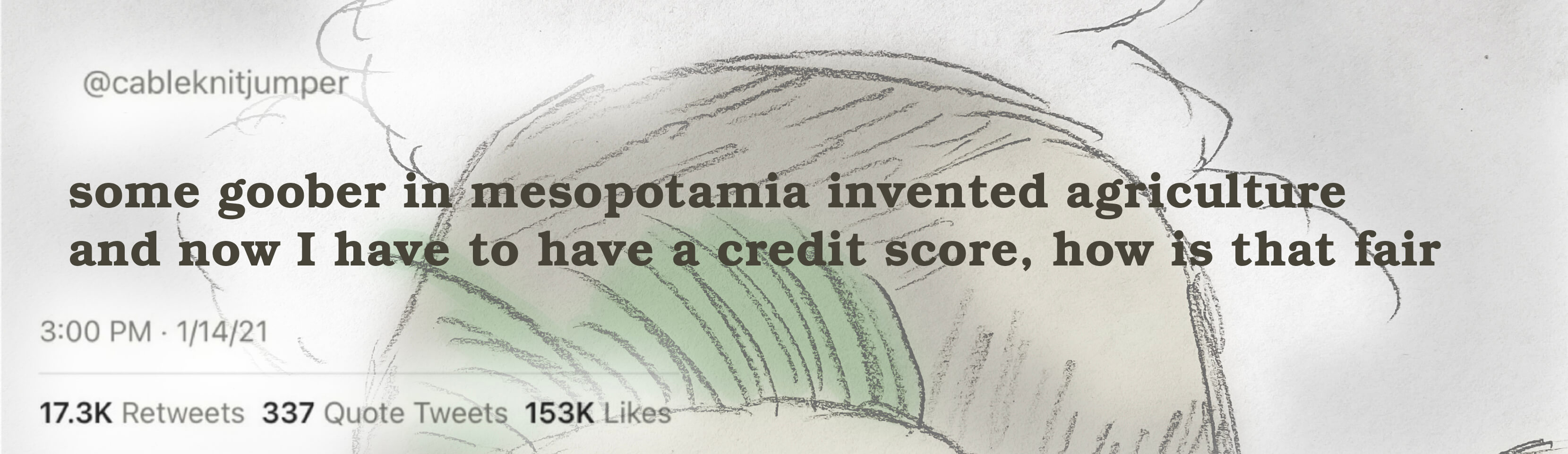
I’ve seen tenderqueer frogposts, frogposts that take the form of Sailor Moon screenshots, frogposts that glorify the peaceful and bucolic lives of gnomes or hobbits or wizards over animals, frogposts where the woodland creature in question is developing burgeoning anarchist sentiment, frogposts where the woodland creature in question is instead a seal, or a baby capybara, or bunnies who are safe from emails. The core aesthetic of the genre has been used to sell T-shirts and mugs and stickers. One of the first posts I saw that felt like it contained the frogpost ethos—proto-frogposting, or perhaps tadpoleposting—didn’t even reference animals at all:
Frogposting is also more interesting, creative, and funnier than some of the other genres of nostalgiaposting: for instance, the “It’s 2002. You’re logging onto AOL for the first time on the family computer. Your mom brings you some chocolate milk. Everything is alright in the world.” genre feels like it’s just half a goose-step away from the “This is what they took from us” and “We used to be a real country” posts.
But when one thinks of people yearning for a retvrn to a simpler, more idyllic, natural era, it’s rarely the blue-haired pronoun crowd in question. Rather, it’s fascists—the Roman statue profile pic gang on X and the cottagecore tradwives of TikTok. Is there an “I wish I was a frog on a leaf in a forest” to white supremacist pipeline yet?
***
It’s true that this tension—between embracing modernity and technology, and rejecting them both in favour of a return to the earth—is a long-running one that, like the tension between more government and less government, can split across the right-left divide. Climate activists are usually leftists, but, in my experience, cottagecore enthusiasts more often hearken back to other aspects of the pre-civil rights era than just the bonnets and the butter churning.
Regardless, it doesn’t take any particular stripe of political affiliation to recognize that so much of contemporary technological progress is a form of subtraction by addition as the bait-and-switch of enshittification ruins yet another fun new toy.
Before Trump won the 2024 American presidential election, I found myself running into a very similar issue when my friends and I found ourselves hating the same ruling-class centrist technocrat politicians the far right did—the Trudeaus, Clintons, Bidens, and Obamas of the world. Though we scorned and dunked on them for different reasons and from vastly different perspectives, both sides seemed to recognize their leaders were not there to help the common person.
On social media meme pages, where political affiliations are typically not printed in bold type but in cadences of online speech or meme dogwhistles, lines can sometimes get blurred. Ecofascism and Malthusian anxieties about overpopulation can go hand in hand with Unabomber anti-technology screeds and climate doomers. I’ll find myself six or seven memes into an IG carousel before I hit a false note and realize the admin and I have very different politics, after all.
And while it can be hard to have hope in humanity when humanity looks like *gestures broadly at the year 2025*, any shift from gallows humour towards nihilism only seems to serve the interests of those who benefit when nothing changes. Part of the issue is being able to imagine alternative modes, something that frogposting gestures towards but seems incapable of affording more fully.
***
I rewatched M. Night Shyamalan’s 2004 movie The Village recently. It’s a (spoiler alert) tale of what a yearning for the bucolic past looks like when taken to extremes. Funded by a narratively convenient diegetic billionaire inheritance, a handful of white families in late twentieth-century America start life anew in a clearing in the middle of a ‘wildlife preserve,’ where they engage in 24/7 pilgrim roleplay and inculcate their children with a fear of monsters lurking in the woods.
The tension between their old-school aims and the reality of the crime-ridden modern life lurking at the edges of their heavily manicured prelapsarian paradise comes to a head when one of the next generation’s eldest is fatally wounded at the end of the second act. To seek out life-saving medicines beyond their borders, or to hew to their backwards-looking ideals?
It’s a half-dozen major plot holes in a trench coat and an incredibly corny Twilight Zone twist masquerading as a full-length movie, but in his climax and denouement, Shyamalan does hit on a powerful truth about rejecting modernity in favour of antiquity: Whether it’s seen through sepia-tinted, rose-coloured glasses or in a magic rear-view mirror, the low-tech, all-natural past was not so great, either.
Transposing that truth onto the logics of frogposting culture, we can imagine scenarios like: That frog never had to pay taxes, but it also was at the mercy of being eaten alive on any given night. That mouse didn’t have a credit score, but it also never got to experience the beauty of reading a long-dead author’s novel and seeing its own experiences reflected in those of a protagonist dreamed up centuries ago. That toad never had to have a side hustle, but it also never got to watch its children and grandchildren play catch together. That newt never had a Grindr hookup; that vole never looked down at the clouds from the window of an airplane.
***
Being human is not and has never been easy—Shakespeare’s thousand natural shocks that flesh is heir to come to mind—but in rejecting humanity entirely in favour of the supposed beauty and simplicity of the animal kingdom, frogposting feels—at the risk of descending into New York Times opinion columnist speak—like throwing the proverbial baby out with the oil-slicked bath water.
Raised in sterile suburbs or concrete jungles, young people in North America today know little of nature red in tooth and claw; it’s easier to imagine the slow-moving, rustic life of a country mouse than the reality that those mice’s lives are hectic in their own ways, even outside the context of man-made habitat destruction: avoiding predators, tracking down the next meal, seeking mates, constructing nests, fattening up for hibernation. That they, too, experience injury, disease, death, loss.
Small wonder that frogposting tends to eschew the creatures modern internet posters do see on a more regular basis: squirrels, seagulls, pigeons, rats. We know their lives are not especially fun, nor is there an idyllic poetry to them. Like us, they live on garbage; they are, in many ways, mirrors of our own experience, entrenched in the grimness and griminess of the sprawling modern human metropolis—caught in the rat race, as it were. Frogposting, by contrast, is about leaving all that behind.
***
When COVID-19 ground the world to a halt in early 2020 and people started on the ‘nature is healing’ posts, many people wanted to claim that it was we humans who were the real virus. The rebuttal, of course, was that indigenous approaches to nature belied this idea; as usual, it was capitalism’s unending death-drive that was at fault. But, after all, it was humans who invented capitalism, and humans who produced a world where capitalism reigns supreme, destroying or subverting everything in its path.
I never feel confident I’m falling on the right side of these arguments. Reading the 2007 speculative-fiction-masquerading-as-non-fiction classic The World Without Us by Alan Weisman last fall, I started feeling a sense of genuine calm as he describes the flourishing plant life taking over in the wake of all humans disappearing.
But it’s a short leap from that to a short story with The Leftovers vibes I remember reading in Adbusters magazine as a youth, possibly written by Douglas Coupland, where chunks of the population literally disappear into thin air bit by bit until the first group, overwhelmingly intelligent people and creatives, are dropped back on Earth to repopulate it. Every ‘humans are the problem’ statement seems to have an implicit ‘except me and my friends’ clause waiting in the wings.
Which is one reason why frogposting feels so amusing to me—its rejection of humanity is inward-looking, not condemnatory. It’s “I wish I was a frog,” not, “I wish the lot of you would turn into frogs.” Maybe this is the real way the posts maintain a noticeably less toxic vibe than some kind of hypothetical Make Animalia Great Again approach.
***
As much as they are originally articulations of a specific person's thoughts and feelings, every internet meme is, by the way it passes between groups of people, whether that’s a few thousand or tens of millions, an expression of a particular culture. Consider the rise of Moo Deng, the baby pygmy hippo from a Thai zoo that took the internet by storm in the idyllic distant past that was late summer 2024.
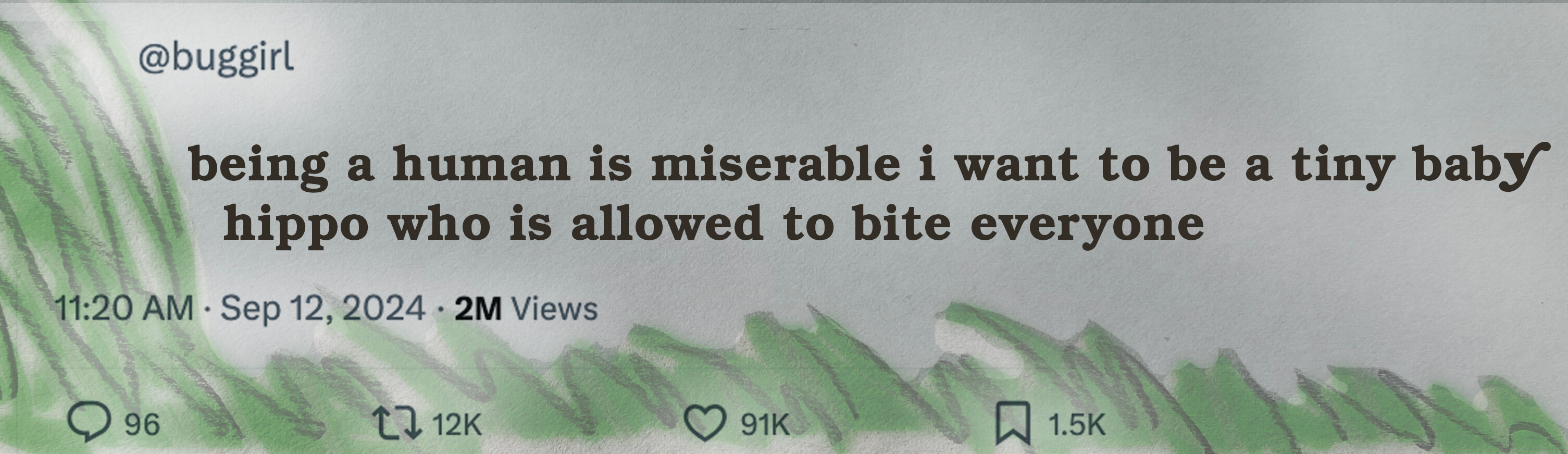
As the Montreal-based writer Daphné B. wrote in an October 2024 article for La Presse newspaper, “If Moo Deng’s been able to charm the internet, it’s not just because of her looks—but also because of her rebellious behaviour.” (Translation my own.)
“In multiple videos,” B. says, “we can see her chomping on a zoo worker’s leg or rearing up, as if she was rebelling, refusing the status quo. Almost as if she’s experiencing a discontent so many of us are familiar with, a precious rage that we should perhaps cultivate—particularly if it’s flaring up in defense of the vulnerable.”
When untold numbers of people see themselves in a screaming baby pygmy hippo, what does that tell us about where things are at? Even before Donald Trump’s January 2025 inauguration, we were all worn thin.
Though Moo Deng has largely slipped from the digital discourse in the year since, the underlying trends that made her brief celebrity possible have only intensified. We all want to scream in a way that won’t result in consequences. We want a life where our basic needs are taken care of. Where, knowing that we’re already in some form of prison, we get a little enrichment time in our enclosures. How much worse could a zoo be than this?
With reality getting bleaker by the day, I spent the early part of this year wondering what kind of animal might capture the zeitgeist next, and whether it would be one that has sharp teeth, or claws.
Before long, I began to see people using the phrasing “the lion does not concern himself with” to describe a kind of over-the-top masculine blasé-ness about inconvenient details. The meme has quickly shifted from initially self-serious to a comedic inversion of itself. But with a relatively rigid phrasing helping make it recognizable, it is too brittle to engender anything like a broader lionposting mentality. For now, at least, the frog still reigns.