On the night of November 13, 2022, a student at the University of Virginia (UVA) shot five others, killing three: Lavel Davis Jr., D’Sean Perry, and Devin Chandler. The shooting took place on a bus returning to Charlottesville from a field trip to Washington, D.C., and set off an extended campus lockdown as police officers searched for the shooter, Christopher Darnell Jones Jr. The next day, Jones was arrested a two-hour drive away, near Richmond.
On the morning of December 6, 2023, on the campus of the University of Nevada, Las Vegas (UNLV), an out-of-work adjunct professor shot six people, killing three faculty members: Dr. Patricia Navarro Velez, Dr. Cha-Jan “Jerry” Chang, and Dr. Naoko Takemaru. The shooting took place at UNLV’s Frank and Estella Beam Hall, and set off a several-hour-long lockdown that continued even after police killed the shooter, Tony Polito, because of reports that a second shooter might still be at large. In addition to the three murdered faculty members, Polito wounded a fourth professor, as well as two police officers with whom he exchanged fire.
On the face of it, these horrific stories share only those general features that unite so many stories of mass shootings. They are two instances of the unchecked epidemic of gun violence in the United States. They are consequences of this country’s nonsensically lax gun laws: both were perpetrated with legally purchased guns. In a slightly narrower respect, they are two examples of the increasingly common phenomenon of mass shootings at schools and colleges.
There’s another shared feature of these two stories: us. We are a group of eight writers—six students and two instructors—whose semesters were marked by these two shootings. Two of us are brothers. Piers Gelly is an assistant professor of English at UVA, and Clement Gelly was an MFA student and instructor at UNLV from 2021–2024. Four of us come from Piers’s fall 2022 writing course at UVA, and four from Clement’s fall 2023 writing course at UNLV. In the spring of 2024, we spent eight weeks in conversation and collaboration, speaking about the parallels and differences between these two shootings, which occurred thirteen months apart. We read and write together as a way of investigating a feature of mass shootings that is rarely discussed: the long aftermath of these terrible events in the specific context of an academic community. Our hope was to use the unusual and unfortunate parallelism between our stories to start an inter-campus dialogue, and to contribute the results of that dialogue to the ongoing discourse on gun violence—and desperately needed gun control—in our communities.
We are in no hurry to “move on” by manufacturing closure where none exists. Students at both schools continue to grieve. Our schools are still wrestling with how to speak about these deaths; we have not yet figured out how to renegotiate our relationships to the spaces where these acts of violence took place.
At UVA, the garage where the shooting took place reopened almost immediately afterward. The university’s official memorial is a tree planted nearby, along with a plaque listing the names of the victims. A minute’s walk away is UVA’s Beta Bridge, which has long been a living, self-governed writing space where different student groups share announcements, condolences, and congratulations. (When Piers and Clement’s parents were married, shortly after finishing graduate school together at UVA, their friends painted this bridge with their names in celebration.) Standard practice is for painters to leave one another’s messages untouched for a few days at most. But after the shooting, students turned the bridge into an unofficial memorial, painted with the names of Davis Jr., Perry, and Chandler. The memorial message set a record of 528 days—far outstripping the previous record of 53 days, for a 2007 message in solidarity with the victims of the Virginia Tech shooting—until an anonymous group of students took it upon themselves to paint over the mural, suggesting in an open letter that “The memorial had begun to degrade, while the tree nearby has begun to sink its roots and thrive.” There was a powerful outcry against this gesture; students repainted the bridge within the day, and as of the time of publication, the memorial still stands, having once again set a record for longest-standing message.
At UNLV, some two years after the shooting, the administration is still raising funds for a memorial garden. There are, outside the reopened Beam Hall, six murals from students and faculty honouring the victims. Inside, encased in glass, are four thousand origami paper cranes that students and faculty folded in their remembrance as well. Of the flowers, signs, and mementos placed outside Beam following the shooting, some have been preserved in a special archive created by the UNLV library. But some of the unofficial memorials of that day also remain: mobile security camera stations, gun-carrying security guards, and a heavier police presence. They contribute to some students’ sense that the shooting isn’t past yet.
And you could argue that even at UVA, three years out, the shooting isn’t a thing of the past: only two months ago, in November, was Jones finally sentenced, receiving five life terms plus twenty-three years. By now, half the cohort of students who were enrolled during the shooting have graduated, taking with them the fragile, short-term, unofficial memory of what happened, and leaving behind only what the institution chooses to pass on.
In these essays, we’ve tried to record what UVA and UNLV can’t memorialize officially: the variety of responses to a mass shooting in the community where it takes place. No one person’s story can stand for the whole, and we don’t want it to. It’s too heavy a burden for a single person to hold. Instead, we believe there’s value in an accumulation of stories, which, in their parallels and contradictions, might help to give readers a sense of the larger narrative. We acknowledge that we are not the primary site of the tragedy—none of us were shot, nor present when shots were fired, though several of us were nearby—and for that reason, we are uncomfortable calling ourselves “survivors.” Nevertheless, each of us identified with the poetic formulation that, as one of our members put it, our schools got shot. This collection of essays is thus an attempt to speak about a collective trauma with a collective gesture.
Our title is borrowed with gratitude from Jo Ann Beard’s 1996 essay “The Fourth State of Matter,” which describes a shooting at the University of Iowa in which several of Beard’s colleagues were murdered. Beard herself was home at the time, not at school; but in her essay, time and space become malleable as she imagines her way into the last moments of her friends’ lives. The essay ends with Beard’s narrator alone with her dog, the day after the shooting, sitting in a moment of eerie stillness.
“In a few hours,” she writes, “the world will resume itself, but for now we’re in a pocket of silence. We’re in the plasmapause, a place of equilibrium, where the forces of the earth meet the forces of the sun. I imagine it as a place of stillness, where the particles of dust stop spinning and hang motionless in deep space.”
Nobody would choose to inhabit such a pocket of silence, this terrible stillness of grief and fear, but we’re grateful to have had the chance to keep one another company there, for whatever that’s worth—not comfort, never closure, but certainly solidarity.
Grace Burke
Natalie Burke
Dara Cange
Christian Dow-Murguia
Alexandra Garcia Ortiz
Clement Gelly
Piers Gelly
Saarah Majid
January 2026
*
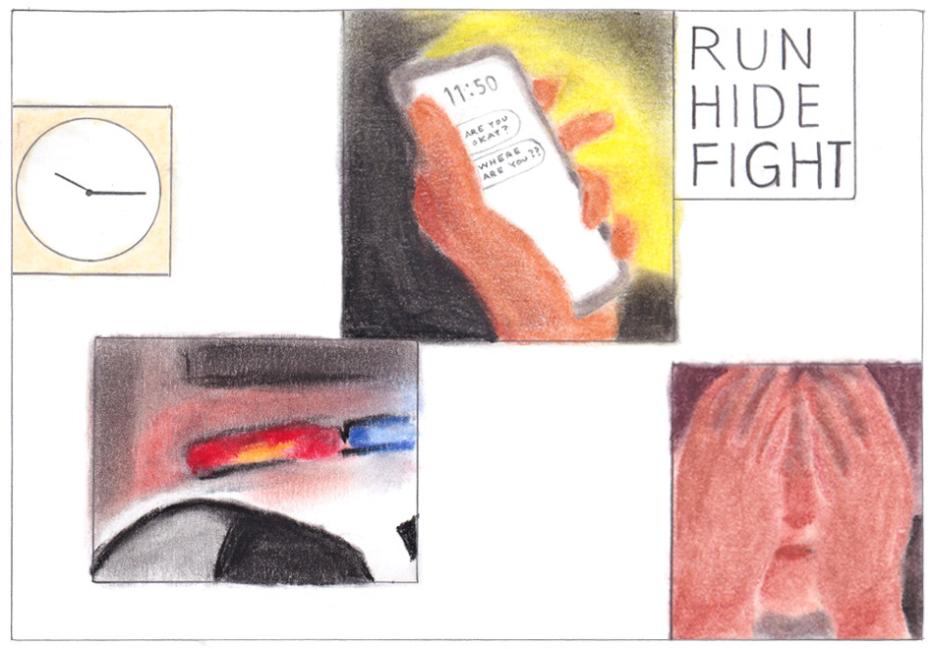
There’s this park on campus I frequent because it’s the perfect place to run. Its terrain is flat and shaded, a nice break from the endless rolling hills of Charlottesville. In September 2022, when I began running in this park, my visits were filled with relief; this part of my run was relaxed, and I could admire the perfectly manicured trees around the perimeter of the central soccer field. On the night of November 13, 2022, I played soccer there when everything went silent. RUN HIDE FIGHT was flashing across everyone’s phones.
A frenzy followed: everyone rushing to cars, younger players pleading for a ride home. A friend and I jumped into another friend’s trunk. The silence in the car was almost too silent; you could hear people holding in tears or gasping for air as we drove through campus. I held my friend’s hand in mine.
When we pulled up to my dorm, I saw two figures banging on the door. My instincts took over any rational thought; I found myself running into my friend’s dorm and lying on her floor. We were too frightened to speak, and for hours, my thoughts were muted by the police broadcast as they searched for the shooter.
But what I remember most is waking up the next morning with a sense of disbelief and heartbreak. No one knew what to do, but life could not simply move on. I could feel the sense of brokenness throughout campus, but my thoughts were drowned out by tears and the rustle of fabric as we hugged those close to us. So much information was being shared, both in the media and to the university population, but none of it fully set in. For these few days, the world around us seemed to disappear. There were memorials and speeches and more texts from concerned loved ones, but the silence surrounding grounds spoke larger than any of these efforts.
I returned home from what was my first semester of college a week early due to the circumstances. My mother cried when she saw me for the first time in the airport. I will never forget the relief in her eyes at that moment, seeing me home when others could not be. At Thanksgiving, instead of asking how my first semester of college went, my relatives asked questions about the shooting. These conversations felt fictitious, and the looks in their eyes only further worried me at the current state of gun violence in our country. Rather than lie and say that anything would get better, they offered hugs and soft smiles in silence.
I went to a football game on Thanksgiving weekend with a friend of mine. Down on the field, on an advertisement board, a “UVa Strong” poster caught my attention. My friend pointed out the tears streaming down my face. Her eyes met mine and she went silent. Neither of us had the correct vocabulary to talk about it, but I could feel her love for me.
Over a year later, the world seems to have moved on at first glance, but reminders of this night live on every day. I have slowly made my return to this park on North Grounds. At first I fully avoided it, discomforted by the memories it could possibly evoke. Each visit welcomes more comfort, but I have yet to experience the serenity this place once brought me.
Recently, I was fitted for a ballistic vest when working with a local EMT agency and learned that one of the units from this station responded the night of the shooting. This fitting, while simply a procedure for onboarding, brought the events of the shooting back into my mind. I remembered the world we live in, that shootings can and will happen on grounds. Only now, instead of running away from it, I would be running toward it.
—Grace Burke
*
In the semester following the shooting, my final semester at UNLV, the new security guards feel like the only lasting sign of what happened.
The guards always seem to stare at me, suspect me, furrow their brows. It makes me feel a greasy static and I slide back into the day of the shooting, watching students sprint out of Beam Hall while I walk past, stop, step closer, try to understand why they’re running and why squad cars are screeching up and cops unloading rifles. Emergencies don’t happen in real life, so I stood there in a movie.
I was in a movie. Months later, the Vegas police released their body and dash cam videos of the shooting response. When I found out, I spent a whole day scrolling through them on YouTube, trying to find myself in the footage, but I couldn’t. I found one clip where I know I should’ve appeared, but the footage is blurred out to protect my privacy—or so I assume. I watched the police officer kill the shooter, ten feet from where I’d been standing minutes earlier. I felt the twisted longing to be closer to that moment. Or to be much further away. If I try to remember myself there, standing in the grass, it’s hard to stay with the thought. I glance off, imagining myself running closer or running away, wishing I’d done anything except stand still.
I feel as if I’m moving through water. I am taking tentative steps backward, and then forward again. I am texting a group chat to avoid the area. I’m turning to see a woman lean out of a door and tell me to get inside. I’m reading the text “Run, Hide, Fight.”
I’m outside the English department, where my cubicle is. I’m upstairs, where a professor says he’d just heard machine gun fire. I’m in Carlos’s office with the lights off, drinking a Capri Sun. I’m eating a Xanax. I’m sitting on the carpet floor with a half-dozen faculty and as many grad students. I’m hearing in a group chat that thirty people were killed. I’m being offered donuts and cookies, because it was supposed to be the last day of class and all of us have bought treats for our students, and none of us can bear to eat them ourselves. I’m emailing all my students to see if they’re alive. I’m texting my family that I’m okay and my phone dies. I’m in a stairwell with my hands up, walking past a police officer in tactical gear, his rifle at the ready. I’m in Carlos’s car, driving home. I’m smoking five cigarettes in a row next to Heather’s pool.
I’m driving past school two months later, in the car of a Vegas magician, and for a second, like magic, I’m trapped in the English department again, and then just as soon I’m back in the magician’s car talking about his show.
I’m at the UNLV pool and run into one of my students from the class that ended with the shooting. He’s the lifeguard. We had such a great class, I tell him. It was terrible, the way the semester ended… We didn’t get any closure to it. He nods. I mean…the more terrible thing was the three professors being murdered, I try to clarify. Rather than the class not having closure.
I swim laps as he circles the pool lazily, whistle around his neck. I want to push myself until I’m totally exhausted, but I don’t do it. I stop short. I wonder, with a pang of self-consciousness, if my student notices.
—Clement Gelly
*
Usually my days are full of noise. I wake up to an alarm, listen to music while I get ready to go to class, hear my professors speak through microphones in large lecture halls, listen to more music, talk and laugh loud with friends, and eventually fall asleep to white noise. I never realized how the sound around me is never-ending. When the noises stopped, I felt chills go down my spine.
On November 13, 2022, at 10:32 p.m., my mom texted me, “Where are you?” Shots had been fired in Charlottesville. I froze; every sound in the room was gone. Shots fired in Charlottesville were nothing new, but active shooter texts were. This was my first semester at UVA, my first time living far from my family, and the first time I had experienced a shooter targeting students at my school. We had always been prepared for something like this, but I never imagined it would actually happen at any school I was at.
What we didn’t know: where the shooting had taken place, where the shooter was going next, if we were safe. The noise rushed back in: people made phone calls, people cried, people moved furniture to barricade the doors, received text alerts from those checking in to make sure we were safe. It was so loud and so unbearable that all I wanted was for the noise to stop. A close friend texted: she was on the bus. She had felt the heat of the gun. She told me who was holding it. Once again, I was frozen. I couldn’t think, couldn’t hear. These pieces of information made all the noise stop.
I knew the shooter. I had spoken with him. We shared mutual friends. I felt like I was sinking into the silence; the only thing there with me was my thoughts, which became deafening. When I woke up, he hadn’t been caught yet. Hours and hours of sheltering in place, in and out of silence, with no idea what to do. I couldn’t help anyone, and no one could help me.
—Dara Cange
*
I woke up early on the morning of December 7, 2023, and started getting ready for my classes, and it took me fifteen minutes before I realized that I didn’t have anywhere to go. It was the moment for me when the reality of what had happened started to be processed.
The day before, I had been on my way to meet a professor. As I got out of my car, I heard garbled announcements and sirens but didn’t understand what was going on. I remember seeing the building I was heading for and thinking I could shelter there. But a wall of people ran toward me, and fear took over. I remember finally hearing the announcement: “RUN, HIDE, FIGHT.” At a friend’s off-campus apartment, we doomscrolled between non-stop messages from family and friends, waiting to see anything that would give us clarity or reassurance. But it was all disinformation. Images from the 2017 Vegas shooting were mixed into those of the current situation.
I didn’t get shot, and I didn’t die. The event was over and people would move on, so I believed that I shouldn’t feel bad and tried to act like nothing was going on. I was fine. I thought that’s how I should feel. I didn’t get shot, I didn’t die. And the world moved on, just like it did with every shooting in America. I felt constantly drained; I was sleeping, but I never felt rested. When my friends invited me to go to an immersive art exhibit, I agreed, because I wanted to not feel so alone.
Inside the exhibition, noise and blinding lights helped distract my brain, but I still felt off. I tried to stay active and not let my feelings affect my behaviour. My friends had all gone through the shooting, and they seemed fine. But I couldn’t stop feeling the urge to cry. I found a strange part of the exhibit with a talking robot, and I felt my mind quiet. I don’t think I had any great revelation. I just finally processed the raw input of what had happened.
Recently, I’ve been walking by the spot where I saw that wall of people three times a week. It’s now marked by a mobile police camera. There are other reminders, although none are official as of this writing. I pass by Beam Hall and its new yellow-jacketed guardians, keeping watch even though it’s empty. The guards and cops on campus eye everyone with open distrust. It’s unnerving when they stare at me with unease every time I enter a building.
—Christian Dow-Murguia
*
November 13, 2022, 10:15 p.m.
Katharine was already asleep when I got home from a run. With great stealth, I manoeuvered in the darkness as I conducted my bedtime routine, but as I crawled under the covers, my phone rang at full volume. I frantically reached for my phone, not wanting to give up the imaginary medal I had just awarded myself for best, most considerate roommate. My mom had overridden my Do Not Disturb and sounded relieved to hear my whisper-screams as I tried to explain that she should text me instead. Her panicked voice cut me off, exclaiming her gratitude that I was safe and alive.
November 13, 2022, 11:15 p.m.
My AirPods were flooded with the sound of the police scanner. Katharine’s chest was still rising and falling in peaceful slumber. I reminded myself to text her mom that she was safe in our dorm room. A friend I hadn’t talked to since fifth grade checked in to see if I was okay.
November 14, 2022, 1:15 a.m.
It was a sorority girl who got shot on a university bus on her way home from a frat. She may be dead.
November 14, 2022, 1:20 a.m.
The shooter is in the fitness centre. Or maybe at Grandmarc Apartments.
November 14, 2022, 3:15 a.m.
Shooter still at large.
November 14, 2022, 6:15 a.m.
I woke up to the sound of my phone ringing again. Katharine was still asleep. It was my uncle in New York calling with an offer to drive down and pick me up immediately. I still didn’t know what exactly had happened or what exactly was going on.
November 14, 2022, 7:30 a.m.
I woke Katharine up. I watched as her mouth fell open when I told her that there had been a school shooting last night. I confirmed that all our friends were safe. She didn’t say anything, but her mouth stayed open as she scrolled through her phone.
November 14, 2022, 8:30 a.m.
A friend in Sweden asked me if I would consider transferring from UVA. The weight of how fucked up the United States is made my stomach hurt. “No,” I responded through an incongruous chuckle, “school shootings happen everywhere in the US.” I counted on my fingers how many people I knew personally who had experienced a school shooting. I had to use both hands.
November 14, 2022, 8:30 p.m.
At the vigil that night, tears streamed down my face as the reality of it all started to set in. The glow of the candlelight illuminated countless grieving faces. I had a naive thought that maybe our school would be the final straw, that maybe the lives lost at UVA would be the catalyst for change. Two different mass shootings were in the news a few days later.
—Natalie Burke
*
You’re safe.
I was in the passenger seat of my professor’s car as she frantically said, “I don’t know where to go.”
“Anywhere,” I thought, and I may have thought aloud. We fled quickly but carefully through the Thomas and Mack parking lot, and to stop my mind from fleeing as well, I reminded myself, You’re safe.
The traffic on Tropicana is always heinous. On December 6, it felt deadly. Though we were off campus, it was not far enough. I needed to move farther and farther away. I could not be near campus. God, I needed to be farther. I repeated, You’re safe.
You’re safe. You’re safe. You’re safe.
But were they? The professor lamented aloud for the students she could not fit in the car. I checked my phone for updates from classmates. They could have been anywhere. Not everyone was as lucky as I was that day. When I got to my sister’s apartment (You’re safe), I heard back from some classmates (dear friends) who were still trapped. I imagined how it would feel to still be trapped in that horrid place, in silence and suspense.
And I, safe at the dining room table with a glass of iced water and a cheesecake, trembled and cried as if I had any right to.
.
The third night of the semester after the shooting, I dreamt I was in Beam Hall. I had not been in Beam Hall since it happened, but it was just as I remembered it. I took the elevator to the third floor. As the doors slid open, they revealed a concrete prison splattered with dried blood. My heart raced. I ran for the stairwell, placing my steps carefully between splotches of red.
When I escaped, I saw my peers still going about their days, as if they were unaware of the red stains upstairs.
There are many red stains on the campus paths. Most are from rust or sauce or who knows what else. I took special notice of them the day after my nightmare. I noticed a few outside Beam Hall, and against my will I wondered if one could be from that day. I don’t dare look up the footage that would answer my question—it’s best that I don’t know, or else that knowledge would stain all my days as I walk past.
Beam Hall itself is stained, I’ve noticed. The way people walk around it instead of through its space; the way security guards and police cars always seem to be stationed outside; the way a sense of melancholy lingers in the air when you look at it for too long. On very rare occasions, I’ve seen students sitting on the steps. Oh, I tend to assume, they must not know.
There are eleven red stains on the sidewalks in my neighbourhood. I’ve started counting them. I’ve also started noting that loud noises are more alarming than they were before. If I cannot immediately identify the source, I’ll scan my surroundings for any signs of unfolding hysteria. Ambulances fill me with more dread than before, each siren a stain on the air around me.
What I’ve described was not my first, nor my last, nightmare regarding the incident. I hadn’t known I could ever be that afraid. Now I am painfully aware, and it remains a stain on my psyche. I can’t stop noticing the red marks on everything it touched. The UNLV Rebels flag I hung after the incident, suddenly moved by community and resilience—it is a stain in my room. The call log and messages from that day—a stain on my phone. December 6—a stain on my calendar.
Still, I go about my day, as if I were unaware of the red stains on my life.
.
It isn’t quite that the world slows down; rather, somehow your mind is a second behind, as if you’re on the offbeat of the world’s melody. I remember staring out the window, trying to catch the rhythm again, but the wailing of a nearby siren drowned it out. I don’t remember when I caught back up to it. I believe it was gradual, like a heartbeat slowing back to a normal pace.
One day, in January of 2024, I sat on a bench across from Beam Hall. Stands and tents were up for the spring involvement fair, and loud pop music was blaring from the speakers.
I saw a group of friends reunite at their sorority’s tent. They shouted and hugged, and then began to catch up and gossip. As a new song began to play, one girl started to dance, and her friends joined, cheering and laughing. The world’s melody made sense again.
—Alexandra Garcia Ortiz
*
A few days after the shooting, I returned to my on-campus job at the university preschool. In the immediate aftermath, I was absentminded. I had gone from being constantly busy with homework and end-of-semester activities to having all deadlines removed per university action. Other projects or plans that I had been looking forward to for my winter break now seemed to be meaningless in light of everything else. I was eager to go back to work mostly for something to occupy a few hours of my time.
When the first parent came to drop off his daughter, he and the head teacher were discussing what had happened. Moments before he had come, my coworker told me she was surprised to see him back, as he’d had an especially difficult time. His daughter, not even two years old yet, was looking at us, and as she saw I was watching her, she ran to hug me. Her dad laughed for a quick moment before saying, “She doesn’t know what’s going on.”
Before the shooting occurred, I often walked through Beam Hall as a shortcut or a way to escape the sun for a few moments. About four months after December 6, on my way to class, I walked up to the door of Beam Hall and pulled on the handle. I stared at the door for a moment, wondering why it was locked, and tried again before it all came back to me.
We talk about the shooting in practical terms. Beam Hall is often surrounded by bright yellow–jacketed security guards. The university implemented improved security measures, drills, and revised door lockings. At my job, my supervisor informed me they were testing the phone and intercom system again.
Holistically, however, many of our conversations about December 6 fall flat. Grief encompasses a large silence. Mass shootings hold an even larger one: that of unnecessary grief. In many discussions on the shooting I’ve been a part of, I recall phrases like “The events that happened on December 6,” followed by a silence that stretches through a room full of people. When the shooting is mentioned, I find myself sitting in the silence that overtakes the room, thinking again about grief, community, and how it affects us all. In the silence, I am often left to think about the things we talk about, and the things we don’t, and what we carry with us.
—Saarah Majid
*
On December 7, 2023, my brother Clement messaged the family group chat to let us know he was in lockdown. A mass shooting was underway at the University of Nevada, Las Vegas, where Clement was a grad student and instructor in the creative writing program.
In a series of text messages, Clement narrated what seemed to be happening, though he didn’t have much more information than our frantic Google searches could provide. He had seen people screaming and rushing out of a classroom building. He had seen six squad cars pull up and disgorge a crowd of police officers with machine guns. He had made his way in a daze to the English department, where some of his professors were sitting in the dark with other graduate students; some of them had heard gunfire from an automatic weapon. Information trickled into the dark room via text messages, which Clement relayed to us as he received them: there was one shooter, or two or three; the number of victims might have been thirty-two, or maybe it was “only” a handful. Then it seemed the shooter had been killed, though the lockdown remained in place. It was the last day of the semester, so everybody was offering one another treats that had been intended for their students, but nobody was hungry. My wife phoned Clement and managed to get through, but then his battery died, so we had to wait.
I wish I could say that the feeling of waiting was horrifying for its novelty, but instead it was horrifically familiar. Roughly a year earlier, in the early hours of November 14, 2022, I’d woken up to a text message from my mother saying that a shooting was happening at UVA. A cold feeling came over my whole body. I opened my email and found a long stream of warnings from UVA’s campus police, which narrated the previous six hours in escalating waves of horror. UVA on lockdown, a shooter at large, RUN HIDE FIGHT. More such warnings appeared even as I tried to catch up to what had happened and was still happening. I went to wake up my wife, but couldn’t get the words out because I started sobbing.
I spent several hours sitting at my computer in numb shock. I typed #Charlottesville into Twitter’s search function, and discovering an abundance of words with very little information. I saw the same picture over and over, of an ambulance parked outside the garage where the shooting happened, until the previous night’s tweets gave way to older #Charlottesville tweets that referenced the 2017 Unite the Right rally. I got an email with a link to a press conference by the campus police, which hadn’t started yet, but which I signed into and stared at for lack of anything better to do. The chief of police appeared and said that several students were dead, and then another officer called him aside and whispered in his ear; the chief returned to the podium and told us that the shooter had been caught. I remember the cold consolation I felt. It was over, but only in the most limited sense of that word. I still didn’t know if any of my students were dead.
Four hours after his initial texts, my brother messaged us again. He’d made it home. The police had cleared the building, methodically smashing in the doors of the English department room by room, and had finally ushered my brother and his professors outside at gunpoint.
And so this shooting, too, was “over” in that highly limited sense: they had the shooter’s name and an accurate count of the dead, which was “only” three, like UVA. And like UVA’s shooting, the UNLV shooting briefly made national news, for whatever that’s worth. My brother’s friend Meg, a stringer for the New York Times, was sent to report from a reunification centre near campus, but the Times sent her home after thirty minutes. Yet again, the worst had happened. What else was there to say?
I was teaching three writing classes at the time of UVA’s shooting, and in the hours before and after the shooter was caught, I sent my students a series of emails.
UVA’s shooting wasn’t the first time I’d found myself in a role that exceeded the functional core of my job description; I started teaching at UVA in the fall of 2020, fully on Zoom, when students’ illnesses and second-order personal crises grew so overwhelmingly frequent as to seem inevitable, though never quite predictable. At that time, the business of teaching was impossible unless I first attended to the caretaking that my students clearly needed, which ranged from excused deadlines to impromptu advice sessions to an abstract attitude of gentleness that I can’t articulate in terms of details, but which suffused all my interactions with them. For one thing, I started beginning all my email replies with the lines,
Hi [name],
Thanks for reaching out.
This was both an instance of candour—in the fall of 2020, when students regularly went dark for days at a time, I really was always glad to hear from them—and a strategic use of distance, the rhetorical equivalent of a pair of tongs or gloves. What the students needed, I sensed, wasn’t merely solicitude, but also structure. The attitude I was developing and shaping in real time, email by email, was the verbal expression of the only humane pedagogy I could imagine in a time of crisis.
It wasn’t exactly the same, writing emails after the shooting, but rereading those messages now, I can see myself making that same move in the same words.
Hi D—,
Thanks for reaching out. Right now, I’d say that your well-being is the top priority, so yes, please, go see your family.
Hi H—,
Thanks for reaching out. Yes, of course you can have an extension.
Hi J—,
Thanks for reaching out. I suggest that you do whatever you need to do, and we’ll figure it out.
Hi A—,
Thank you for letting me know. I’m very sorry to hear that you’re not doing well, and I’m glad that you’re heading home to be with your family.
Hi Z—,
Thanks for checking in. Yes, please feel free not to attend class.
Hi A—,
Thanks for the quick reply. I’m glad you’re taking care of yourself.
Hi F—,
Thanks for the quick reply. I’m glad you’re taking care of yourself.
Hi D—,
Thanks for this note. I’m glad to hear that you’re taking care of yourself.
Considered as a whole, these words have a vagueness to them—a lack of actionable, directional meaning, and a violation of the standard that I’d insisted my students apply to their own work. True! But useful? I’m not sure, I’d written alongside those amorphous introductions to their first drafts. Use detail, I told them; use narrative, use your own voice, use your visceral sense of the essay’s stakes. If you can tell us why it matters to you, it’ll be very easy for us to care as well. It’s how I taught writing because it’s how I was taught to write. Strunk & White: “A sentence should contain no unnecessary words, a paragraph no unnecessary sentences, for the same reason that a drawing should have no unnecessary lines and a machine no unnecessary parts.” And so on.
But nobody taught me how to write during an emergency. And now that we’ve slipped into a period of history where emergency feels like the usual state of affairs, I’ve had to feel my way through it, devising some best practices from trial, if not error; if I’ve learned one thing, it’s that anything seems to be more helpful than nothing, because the substance of words is less important than their presence. “A sentence should contain no unnecessary words.” Sure. But this presumes an intelligible standard of necessity, and therefore a reasonable place outside the embodied present from which to coolly and calmly assess what must be done and what must be said. Will we ever return to that place? Did it ever really exist?
A few days after the shooting, I remember sitting, once again and for the first time, in the circle of my students. The room was emptier than usual, with a number of vacant chairs representing students who had gone home or simply declined to attend. Classes were cancelled immediately after the shooting, and once they resumed, I made it clear to my students that they should only attend if they felt it would do them more good than bad, but to please let me know if they wouldn’t be there, so that I didn’t need to worry.
I wasn’t expecting to see W—, a football player who was enrolled in the class: the three murdered students were his teammates. After the shooting, I wrote him a note. He wrote back, and shared with me that one murdered teammate was also a close friend from high school. He told me that he might attend class, in order to get back on a normal schedule, and invited me to talk about the shooting even if he attended, because he didn’t want me to feel I had to avoid the topic on his account.
Class had begun, I’d taken attendance, we’d started piecing together a discussion of what to do next, and then the door opened and there was W—. He was wearing a hoodie with the hood up and rubber slides with white socks.
He took his seat while our conversation continued—there was no noticeable disruption that I recall—but I can’t have been the only one to sense that death itself had entered the room. I remember feeling afraid of his pain, and then immediately feeling ashamed of my fear.
The discussion underway was the product of an opening exercise I’d suggested to the students: talk to the person beside you about what you need right now, and then report back to the group. Now we moved around the circled desks, with each pair of students explaining what they’d discussed. Some said they couldn’t concentrate, and needed relief from schoolwork; some said they needed the structure of schoolwork to occupy their minds; one student said she wanted everybody, right now, to share what they’d been through, which seemed to me a heartfelt but inadvisable idea. I reflected most of this back to them, suggesting that we could make the final weeks of class customizable, with various paths they could choose in order to make the course work for them. I wasn’t sure I’d really “said” anything, in the sense of adding new information to the class, other than what they themselves had contributed when I’d given them the opportunity to do so.
W— didn’t speak in class, but, in a gesture that made my heart hurt then, and makes it hurt now to remember, after class he approached me and gave me a silent fist bump, and then he left.
—Piers Gelly